G

AI Built for Chemistry Patents

The Best Chemistry Patent Drafting Tool — Built for Markush structures, stereochemistry, and experimental data that generic tools get wrong.

Get Started - Free

The Highest-Quality Chemistry Drafts, Every Time


DeepIP removes the mechanical work that slows experts down, so chemists and patent attorneys can focus on claim scope, fallback strategy, and defensibility.

Other tools produce generic text. DeepIP produces prosecution-ready chemistry.

Get Started - Free

Why Chemistry Patent Teams Choose DeepIP

Chemistry Patents With Broader Protection & Less Risk

DeepIP helps chemists and patent attorneys turn compounds, structures, and experimental data into prosecution-ready chemistry drafts—while preserving chemical validity, internal consistency, and support from examples to claim scope.

Markush Drafting, Grounded in Chemistry

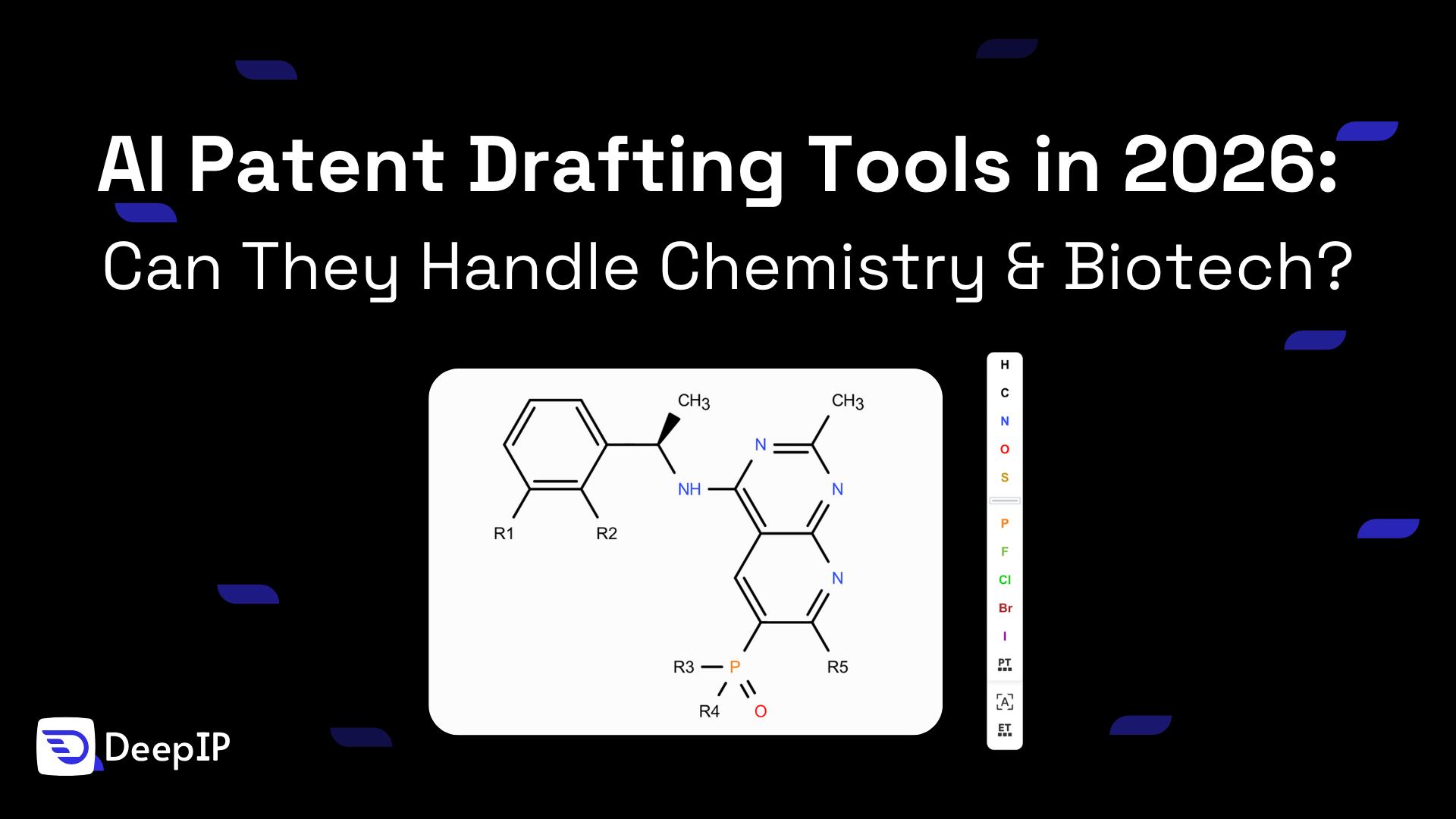
DeepIP suggests an initial Markush formula or genus with substituents, then lets you refine it visually or in chat to build defensible broad-to-narrow fallback formulas. Exemplified compounds stay in view as scope evolves, ensuring coverage remains chemically coherent and grounded throughout the draft.

Preserve Chemical Meaning End to End

Subscripts, superscripts, stereochemistry, symbols, ring systems, and structural notation are preserved across ingestion, drafting, and export.

DeepIP is built to protect chemical meaning, not just document formatting.

Turn Experimental Data Into Patent-Ready Examples

Raw chemist notes, tables, and experimental results are hard to convert cleanly into patent examples.

DeepIP helps structure that material into drafting-ready experimental sections while preserving values, units, ranges, and technical detail.

Get Started - Free


Generic AI is failing chemistry teams.


The difference between fluent and accurate is invisible—until it isn't.
In chemistry, that gap might be your next rejection.
Capability Generic AI DeepIP
Markush & Chemical Structure Handling Treats chemical structures as text strings. Cannot validate valences, connectivity, or Markush logic—generating plausible-looking but chemically invalid claims is common.
Prosecution Risk
Structure-first architecture validates each compound. Markush-aware drafting rules keep genus claims within disclosed support and flag unsupported expansions before filing.
Sequence Listings & ST.26 Compliance No native awareness of ST.26 formatting requirements. Sequence identifiers, qualifiers, and annotations are not preserved or updated across drafting revisions.
Filing Compliance Risk
Turns uploaded sequences into structured, ST.26-aligned drafting context. Identifiers and annotations stay consistent as sequences are added, edited, or renumbered.
Patent Drawings Generation Generic image models produce illustrations incompatible with USPTO/EPO formal requirements—wrong line weights, unsupported formats, missing reference numerals.
Formal Requirement Risk
Generates office-ready patent drawings from disclosure content—correct formatting for USPTO, EPO, and PCT. No third-party redrawing or manual reformatting.
Experimental Data & Disclosure Alignment Cannot map assay results, formulation details, or clinical observations into claim structure. Often fabricates or overgeneralizes beyond the disclosed support.
§112 / Art. 83 Risk
Ingests experimental data as structured drafting inputs, linking each claim element back to specific support in the specification. Full audit trail throughout.
Workflow Coverage Operates as a standalone generation step. Outputs must be exported and manually reconciled with drafting, prosecution, and portfolio systems—context lost at every handoff.
Workflow Fragmentation
End-to-end platform from patentability through prosecution and portfolio strategy. Prior art, drafts, office actions, and portfolio intelligence share one context—no handoff gaps.
Workflow Integration Requires users to leave their drafting environment, copy-paste content, and adapt prompts—reducing adoption and introducing transcription errors. No IPMS integration.
Adoption Risk
Embedded natively in Microsoft Word and IPMS platforms—no new workflow to learn. Delivers +20% adoption and +40% usage vs web-only tools.
Data Security General-purpose LLM APIs often lack zero data retention guarantees. Training data policies vary and may not meet the confidentiality requirements of pharma, biotech, or corporate IP teams.
Confidentiality Risk
SOC 2 Type II, ISO 27001, GDPR compliant. Zero data retention—your data is never used for training. Hosted on Azure US/EU with full segregation and no human access.
Get Started - Free

Trusted by Global IP Leaders

Get Started - Free

Built for the way patent professionals actually work

Secure & Confidential

Work in Word, your IPMS, or the browser. No new workflow to learn — just faster output and fewer errors.

Complete & Reliable

DeepIP leverage better data to delivers reliable insights across the entire patent workflow. 

Embedded where your work

Embedded in your daily tools — Word, IPMS, and Web — delivering +20% in adoption & +40% in usage vs. a web platform.

Collaborative by Design

Work effortlessly across teams and cases — with shared context, consistency, and control.
FAQs

Still have questions?

Contact Us

The Go-To Platform for IP Practitioners

Request Your Trial