Patent Drafting with AI: The 2026 Guide to AI Patent Drafting Tools and Workflows
.png)

Patent drafting is a complex process that demands rigor, precision, and a deep understanding of both law and technology. Every word matters: the way an invention is described, claimed, and framed can determine whether it’s enforceable, defensible, and commercially valuable.
In 2026, advanced AI patent drafting tools are reshaping how patent applications are prepared. Corporate IP teams and external counsel are using AI not just to “speed things up,” but to generate better-structured drafts, explore alternative claim strategies, and maintain consistency across large portfolios—while still meeting strict legal and technical standards.
This guide explains how to use AI in patent drafting end-to-end: from capturing invention disclosures and structuring patent applications, to iterating on claims, specifications, and drawings. Whether you are a seasoned patent attorney, in-house counsel, or newer to the profession, the goal is simple: show how AI patent drafting software can streamline your workflow, enhance quality, and support robust, enforceable patent protection.
In practical terms, it’s a 2026 how-to guide on using AI to draft patent applications without sacrificing legal quality.
Updated for 2026
What Is AI Patent Drafting in 2026?
When we talk about AI patent drafting in 2026, we’re no longer referring to generic text generators that produce vaguely “technical” prose. Instead, IP teams are adopting:
- Specialized AI drafting tools trained or configured for patent formats
- Agentic AI workflows that follow multi-step drafting chains (from claims to specification to abstract)
- Enterprise-grade platforms that meet legal confidentiality standards and integrate with broader IP workflows
These systems help attorneys move from invention disclosure → prior art context → claims → specification → drawings in a structured way, while leaving legal strategy, final judgment, and risk assessment firmly in human hands.
Elements of a Patent Application (And How AI Tools Support Each Section)
To secure patent rights, an inventor must file a patent application with the relevant patent office in each country or region. A patent application is a legal document that claims and fully describes an invention in technical language and in a very specific format.
While many general-purpose AI tools can produce technical documents, patent applications have strict formal requirements. That’s why AI patent drafting tools must be designed to output properly formatted patent sections rather than generic prose.
A basic list of formal elements required in most patent applications includes:
- Title: The name of the invention to be claimed and described by the patent application
- Abstract: A short paragraph summarizing the invention more fully described in the specification
- Patent Claims: A numbered list of sentences marking out the legal boundaries of the invention that the patentee can enforce against alleged infringers
- Related Applications: A list of other patent applications filed by the inventor, including divisional or continuation filings, and foreign counterparts covering related subject matter
- Prior Art Citations: A list of patents and other publications disclosed by the applicant because they may materially affect patentability
- Background: A brief section that outlines the technical field of the invention, the current state of the art, and any drawbacks that reduce the utility of that art
- Brief Description of Drawings: Short descriptions of the subject matter depicted in the technical drawings or diagrams
- Detailed Description: A thorough explanation of the inventive subject matter being protected by the claims, enabling a person of ordinary skill in the art to practice the invention
- Drawings: Illustrations or diagrams that depict structural features or workflows of the claimed invention or method
How AI drafting platforms can help
Modern AI drafting platforms can help draft each section in a structured way. From a single invention disclosure or set of drawings, they can generate initial versions of the abstract, claims, and detailed description, suggest alternative claim sets or titles, and maintain consistent terminology across claims, specification, and figures, especially when managing families of related applications.
However, the public disclosure that comes with filing a patent application means confidentiality remains paramount. Any AI-powered patent drafting solution that doesn’t comply with industry-leading cybersecurity and data protection standards is not a viable option for serious corporate IP practice.

Confidentiality and Security: Non-Negotiable in AI Patent Drafting
When drafting a patent application, the inventor is trading public disclosure for a limited period of exclusive rights. That disclosure often includes sensitive R&D, unpublished data, and forward-looking product plans. For corporate IP teams, any leak—accidental or systemic—can be catastrophic for both patentability and competitive position.
Before drafting even begins, patent attorneys typically:
- Conduct inventor interviews
- Review technical documentation, lab results, and design files
- Compile an invention disclosure that captures the full technical substance of the invention
Only AI platforms with security standards that meet legal industry requirements should be used to process this material. That means:
- Strong access controls
- Encrypted data at rest and in transit
- Clear policies on training data and data retention
- Third-party audits and certifications
The DeepIP platform has been tested and audited to obtain ISO/IEC 27001 certification, a global standard for information security management. It also complies with SOC 2 standards that apply trust services criteria to customer data handling.
In practice, that means patent practitioners can use sensitive materials as prompts for AI drafting without introducing unacceptable confidentiality risks.
Obtaining an Invention Disclosure: Developing Material to Prompt AI Drafting Tools
For most patent attorneys, the first step in drafting a patent application is collecting in-depth information from the inventors. The invention disclosure is studied extensively to understand the nature of the technical advance and what can—and should—be protected by patent rights.
Many companies rely on standard invention disclosure forms to create internal records. However, live meetings or interviews with inventor teams remain critical. They help attorneys grasp the novel and nonobvious aspects of the invention, understand constraints and edge cases, and clarify what has already been tried—and why it was inadequate.
In 2026, this invention disclosure doubles as a primary prompt for AI patent drafting software. The richer and more structured the disclosure, the more useful and accurate the AI outputs.
To make that information truly useful for AI-assisted drafting, in-house or outside counsel should structure the conversation carefully: define the technical field and competitive landscape upfront, explore the specific technical advantages of the invention, and capture diagrams, process flows, and key parameters that reflect real embodiments.
Strong communication skills, plus the ability to work with different personality types, remain essential. AI supports the drafting; it doesn’t replace the nuanced human conversation that surfaces the invention’s true value.
Key Information to Capture for AI-Assisted Patent Drafting
Alongside a thorough description of the invention itself, attorneys should collect several pieces of information that matter whether or not an AI drafting tool is used:
- Prior Art: Previously filed patents and scientific publications affecting novelty and nonobviousness. Inventors are often aware of relevant art that must be disclosed during prosecution.
- Public Disclosures/Commercial Activity: Publications, conference talks, or offers to sell the invention can trigger legal deadlines that risk patentability if filings are delayed.
- Inventor Identities: Every individual making a significant inventive contribution must be named. Failure to properly identify inventors can lead to costly disputes that compromise enforceability.
- Public Funding Sources: If R&D is funded by government entities, that must usually be disclosed, as it may grant governments certain rights in the invention.
In large corporate environments, invention disclosure processes also involve commercial viability assessments. That is important for pipeline and portfolio decisions—but it should not be included in the patent specification, as it has no bearing on patentability.
A well-designed AI patent drafting solution will help ensure that outputs remain focused on novelty, nonobviousness, and technical contribution, not market forecasts.
Patent practitioners using DeepIP’s AI drafting capabilities can realize significant time savings on claims and specification drafting per application. Instead of spending the bulk of their time just understanding and structuring the invention, attorneys can use the disclosure as a prompt, then iterate quickly:
- Generate multiple versions of invention titles
- Explore alternative claim sets aimed at broader or narrower scope
- Request more detailed descriptions for specific embodiments
This keeps human expertise where it matters most—strategy, risk assessment, and legal nuance—while delegating repetitive drafting to the AI.
How to Approach Patent Drafting with AI: Start from Claims or Drawings?
Even with AI-powered tools, patent attorneys still need to choose where to start when drafting a new application. In practice, most attorneys favor one of two common approaches:
- Claims-first drafting
- Drawings-first drafting
AI patent drafting software can support either approach by refining and expanding drafts over multiple iterations. But the choice of starting point remains a strategic one.
Starting with Patent Claims
Beginning with the claims is often favored by practitioners who want to lock in the legal scope early.
Advantages:
- Forces deep understanding of the invention from the outset
- Produces a concise and focused specification, built from clearly defined claims
- Makes it easier to align abstract, background, and detailed description around a well-defined claim set
Challenges:
- Requires more upfront effort to fully understand the invention
- Can be difficult when dealing with highly complex technologies, or when the full inventive scope is still evolving
AI drafting tools reinforce this approach by generating initial independent and dependent claims from the invention disclosure, suggesting alternative transitional phrases or structural variations, and helping attorneys explore different claiming strategies, such as system, method, or computer-readable medium claims for the same core invention.
Starting with Patent Drawings
In a drawings-first approach, attorneys start by creating or reviewing diagrams and figures before drafting claims.
Advantages:
- Helps attorneys visualize the full scope of the invention early in the process
- Makes it easier to spot additional inventive features that might otherwise be missed
- Facilitates incremental refinement as the picture of the invention becomes clearer
Challenges:
- May lead to unnecessary extra drawings, adding drafting overhead
- If claims are left too late, there can be misalignment between claims and a fully drafted specification
AI drafting tools support a drawings-first workflow by transforming visual information into structured written descriptions, generating claim sets that mirror the structural or functional elements depicted in the figures, and weaving those components into a cohesive narrative that aligns the drawings, embodiments, and eventual claim strategy. This allows attorneys to surface inventive features earlier, maintain consistency across the application, and ensure that the specification and drawings work together as a unified technical story.
The Rule of Thumb for AI in Patent Drafting
Whichever approach you choose, you must maintain a proper level of detail throughout. Too much detail can narrow the application to the point that it loses commercial value. Too little can create enablement or subject matter eligibility problems that risk validity in prosecution or litigation.
A useful rule of thumb: treat the patent specification like a technical training manual focused on the invention’s novel aspects, with drawings and description working together so a skilled artisan can reconstruct the invention.
Writing Patent Claims with AI: Iteration, Structure, and Grammar
Most patent attorneys come from scientific or engineering backgrounds, yet soon discover that claim grammar is effectively its own legal discipline. Even when AI generates the first draft, attorneys must still review, refine, and restructure the language to ensure the claim set is enforceable and aligned with the invention’s technical contribution.
A typical patent claim is built around three core elements, each serving a distinct purpose within the legal framework of the claim:
- Preamble: Introduces the invention and defines its general field
- Transitional phrase: Sets the breadth of the claim, typically using “comprising” (open) or “consisting of” (closed)
- Limitations: The list of elements, features, or steps that distinguish the invention over the prior art
Even when these components are present, attorneys must ensure the claim is drafted as a single coherent sentence, with punctuation and structure that clearly separate limitations and avoid ambiguity.
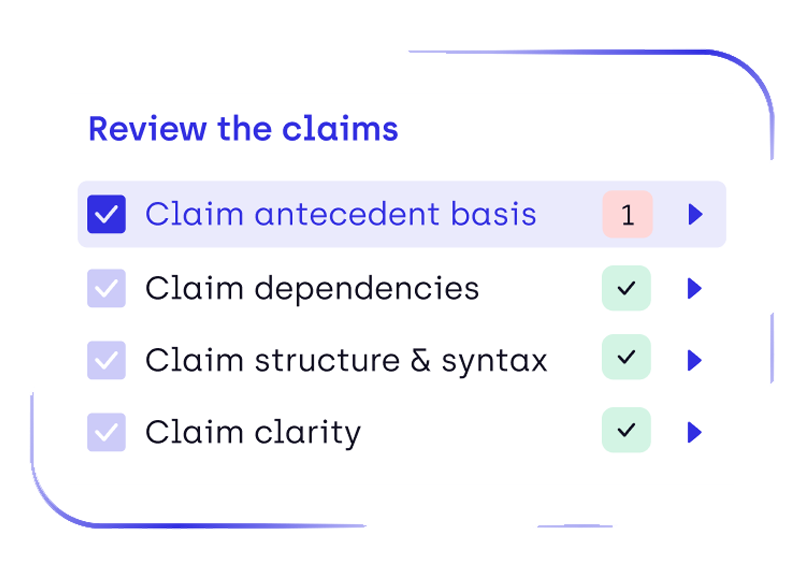
Proper antecedent basis remains especially important. Terms introduced as “a processor” must reappear later as “the processor,” and related elements may need to be identified as “first” and “second” processors when they perform distinct roles. These conventions may appear mechanical, but they are essential to claims that withstand scrutiny in prosecution or litigation.
How AI patent drafting tools can help
AI patent drafting tools are particularly effective at generating several alternative formulations of the same claim, offering different preambles, transitional phrases, or structural arrangements of limitations.
They can also propose alternative claim families for various embodiments, or suggest dependent claims that make a design-around strategy more difficult for potential competitors.
Still, AI-generated claims require human oversight. The attorney must check for grammatical consistency, correct legal framing, and alignment with the specification. That is why the most effective drafting approach in 2026 is iterative.
A common workflow looks like this:
- Use the AI to generate multiple draft claim sets based on the invention disclosure or drawings
- Review those drafts for clarity, precision, and legal sufficiency
- Ask the AI to refine specific segments—for example, to broaden a limitation, simplify the preamble, or harmonize terminology with the embodiments described in the detailed description
DeepIP’s AI drafting capabilities fit naturally into this iterative model. By drawing on inventor interview notes, diagrams, and supporting documentation, the system can propose a wide range of independent and dependent claims to help practitioners build an entire family of related applications.
Attorneys retain strategic control over what ultimately gets filed, while gaining the efficiency and structural consistency that AI-assisted drafting provides.
Drafting the Patent Specification: Using AI to Generate Enabling Descriptions
Although claims are technically part of the specification, practitioners usually use “specification” to refer to the detailed description that supports those claims. When patentees run into serious legal issues with their specification, it’s usually because an examiner or judge concludes that the written description does not enable a person of ordinary skill in the art to practice the claimed invention.
AI-powered patent drafting tools can help show possession of the invention and satisfy the enablement requirement—especially when used iteratively. No AI tool can provide a perfect specification after a single prompt, but successive prompts and refinements can result in a full, exact, and thorough disclosure of multiple embodiments.
The enablement requirement reflects the core patent law bargain: in exchange for limited exclusivity, the patentee discloses enough technical information that the public can practice the invention once the patent expires. Differences in case law across jurisdictions affect how much detail is necessary. For example, following the US Supreme Court’s Amgen v. Sanofi decision, there has been increased scrutiny on whether genus claims disclose enough embodiments across their full scope—especially in chemistry and biopharma.
Regardless of technical field, practitioners can follow several best practices when using AI to draft specifications:
1. Use specific technical language for embodiments
While broad, generic terms help capture scope in claims, the description of embodiments must be concrete enough to demonstrate possession. Relying exclusively on generic AI-generated phrasing can raise questions around subject matter eligibility and enablement.
2. Draft complete, stepwise explanations
Remember that a patent application should function like a technical manual. AI drafting tools can produce detailed “roadmaps” for how to make and use different embodiments of the invention.
3. Highlight structural novelty, not just function
It’s often easier to explain what the invention does. But focusing on structure—how components differ from the prior art—makes enforcement more effective against manufacturers and intermediaries, not just end users.
4. Clarify shortcomings of the existing art
The background section is an opportunity to explain deficiencies in the prior art and how the invention overcomes them. AI can help identify and articulate these shortcomings, which in turn supports enablement by making the advance clear to skilled artisans.
Whether starting from diagrams, claims, or an invention disclosure, DeepIP can generate properly formatted specifications that serve as strong first drafts, then be refined by human counsel. Attorneys can prompt the system to:
- Provide additional written support for specific claims
- Emphasize component-level descriptions
- Tailor the level of detail to different jurisdictions or filing strategies
Used thoughtfully, AI drafting tools can support each of these practices by providing detailed, component-level descriptions, suggesting alternative structural formulations, and surfacing prior art context that clarifies how the claimed invention differs from the existing landscape. The key is that the attorney remains the editor and architect, while the AI provides breadth and speed.
Best Practices Checklist for AI Patent Drafting Tools
By 2026, the AI tooling landscape for IP is crowded, and many solutions look similar at first glance. A simple way to cut through the noise is to evaluate AI patent drafting software against a clear set of criteria.
Corporate IP leaders and law firms evaluating AI patent drafting software should look for:
- Enterprise-grade security: ISO 27001, SOC 2, clear data handling policies
- Patent-native outputs: Claims, abstract, background, detailed description, drawings description—rather than generic language models
- Configurable workflows that reflect your drafting style: Claims-first, drawings-first, or hybrid
- Support for complex domains: Life sciences, chemistry, biotech, pharma, materials, software-intensive systems
- Versioning and audit trails: For internal review and compliance
- Fine-grained control over tone and terminology: Especially across large portfolios
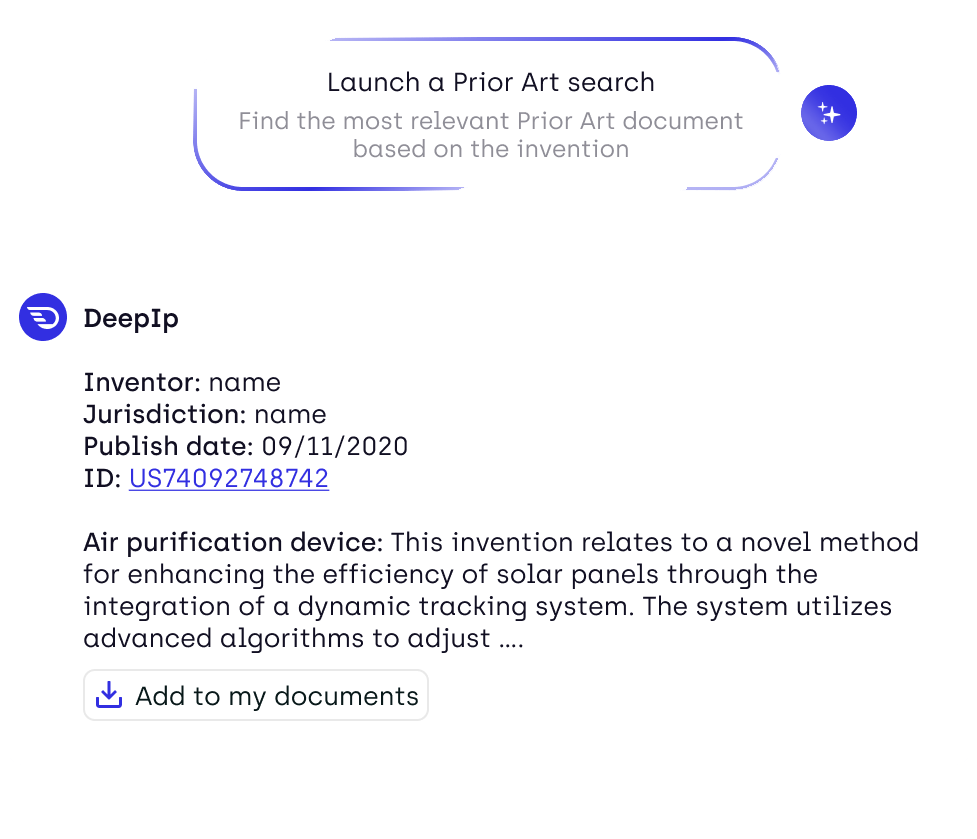
- Tight integration: With prior art search and portfolio tools, so drafting doesn’t occur in isolation
The goal is not to replace attorneys, but to free them from boilerplate drafting so they can focus on strategy, risk, and high-value decision-making.
.png)